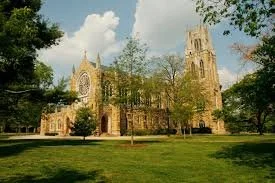
So, when I first got to seminary, I felt like a nerdy kid in a book-laden candy store. The campus of the University of the South at Sewanee is a fantasy world. It sits perched on the southern tip of the Cumberland Plateau. It’s high enough, and the elevation changes so fast, that you can drive around campus in the fog, then head down the mountain, and emerge into a rainstorm: what you thought was fog was someone else’s cloud.
It’s magical. Walking around the place, you forget you’re in the American South. Us students and professors still wear academic gowns to class and around campus. You watch their Harry Potter robes flapping behind them as they bike from one end of campus to the other. You imagine Ron Weasley stumbling out of potions class while you stroll between old stone buildings.
The carillon chimes out Anglican hymns high atop All Saints Chapel. A building so large it would hold six or seven Emmanuels, and is only called a “chapel” because it is located on a campus. There's the Sewanee seal on the ground in front of the chapel, and cursed be to those who trod upon it before graduation. You will see students hop over it or walk around it as naturally as breathing.
This is where we got and raised Cotton and Lola, two dogs that were known, it felt like, by nearly all the 1,500 students.
But the library’s where we’re headed on our campus tour today. The library serves both the undergraduates and the seminarians, and it’s a bookworm’s dream. The first and second stories host most of what the undergrads’ll need, and the seminary library perches on top, overseeing the campus and all who wander its green paths. This was the first place that I carried stacks of books so high my chin had to chip in to balance them, the place I where I first met Jim Dunkly, the seminary librarian.
Jim Dunkly was a big fella, built kinda like Yogi Bear but with jowls like Deputy Dog. If you needed help finding a book or couldn’t even think of where to begin on a topic, he was the man to see. And that man, y’all, he was brilliant. The kind of brilliant that was both endearing and a little frustrating.
One time, I don’t even remember what I was working on, I went into his office and found him mostly obscured by piles of tomes and loose papers and three book carts. I told him what I was working on and asked for recommendations. He nodded and said, “Great. How’s your French.” Nonexistent. “Not a problem. German?” Nope. “Latin?” Uh, four years in high school?. “Greek?” Not yet. “Hebrew?” Not yet again. “Ok, so just English then.”
The thing is, while it felt judgy, it wasn’t. He was just narrowing down in his card catalog brain which shelves to take me to. And then he did, directly. He walked me straight to about twenty-five books that I just had to consult before writing my three-page essay.
The real treat, though, was when, on occasion, his list of must-reads included something from the rare book collection. Y’all. That locked cage held Sewanee’s most treasured books, including an original 1549 Book of Common Prayer, complete with hand-written notes in the margins from some 16th Century kid practicing their letters.
Be still my nerdy heart. Some of the books had old chains dangling from their spines, some were in remarkably good condition, all smelled like centuries themselves...and we could actually remove them and consult them at our library desks!
Now there was one book in there, not terribly old but pretty darn unique. It was beyond even Dunkly’s linguistic prowess, which made it all the more impressive. It was a copy of the Bible translated into an indigenous language from the Andes.
There’s a school of missionaries that take their approach a little differently from what you might imagine missionaries do. Instead of going into a far-flung place and preaching conversion and coercion, their work consists of learning unwritten indigenous language intimately for as long as it takes.
They work with the community, talk to everyone of every age, and learn the intricacies as best a foreigner can. And then, again working with the community, they create an alphabet. Once that’s established, the missionaries provide a translation of the Bible in the brand-new alphabet specific to that community’s language.
The community then does whatever they want with the Bible and moves forward with a writing system that didn’t exist before. Sometimes this leads to conversion, sometimes it doesn’t. But sometimes words and concepts don’t translate all that well, if at all. So the missionaries have to get creative. And that especially unique Bible in the rare book collection at Sewanee has one of those creative moments.
In this passage from John, Jesus weaves a confusing metaphor involving sheep and shepherds and gates and pens and robbers. The disciples don’t get it, but they never really do. So, he’ll explain what he’s talking about, and ultimately lands on calling himself the Good Shepherd. Beautiful. Simple enough, right? As it turns out, not quite.
That indigenous community in the Andes didn’t keep sheep. In fact, they’d never seen sheep, never even heard of ‘em. So, the missionaries could create a word for sheep and teach the people what it meant. But as solutions go, that wasn’t great.
For one thing, you’d have to explain an animal that didn’t exist in their world. Then you'd always need to have someone around to explain what the critter was, which defeated the purpose of writing something the community could use without the missionaries around.
And also also, it meant telling the story of Jesus in a way that felt foreign, settled in a place so distant that you couldn’t even picture what their animals looked like. So the missionaries made a choice. Instead of Jesus shepherding a bunch of sheep, he became a shepherd of llamas. And the story clicked. It was local, it was real, and it was theirs.
That’s why a copy sits in the rare book collection at Dunkly’s fingertips. Not because it’s old but because it’s brilliant. If you think about it, whether Jesus is talking about sheep or llamas or yaks or emus or whatever you’ve got, the meaning of this story’s the same. Jesus is our shepherd, providing for our needs, laying us down in green pastures, reviving our souls.
You know, I think most of us know these stories so well that we sometimes miss the wonder of them. It’s hard for me to imagine what it means to hear this for the first time because the first time was so long ago. I guess I’ve been taking the Good Shepherd for granted.
There’s so much love that goes into this careful work. There’s protection and care, nurturing, sometimes bottle feeding and wound tending. There’s visits from the vet and running off coyotes -- or whatever predators wander your lands.
There’s a gentle hand and a caring heart and a deep gratitude for the animals themselves. And there’s always the concern that something might happen to them in spite of all your best efforts. “I will lay my life down and lift it up again,” Jesus says, the full extent of how far he’s willing to go laid bare. There’s so much wonder to that. That someone who’s never met me’s willing to come into my life and do all those things for me. What did I ever do to deserve that?
I don’t think it was really until I was walking around Sewanee taking Cotton and Lola on a romp, that I began to understand some of this. In addition to all the other wonders, Sewanee has an amazing cemetery.
It drips with moss and hanging branches and the gravestones go back far enough to remember when this country split in a Civil War. I was strolling between graves, and something about the gravity of that place -- maybe the magic of it, too -- clicked.
Here were a thousand departed souls, many of them on the wrong side of history of that war, but faithful enough to land here with a cross on a stone marking their departure. Sheep gathered in to this safe and quiet place alongside all these others, others who just as easily could’ve been enemies as friends. All held in the same sheepfold.
It’s a rare thing these days, just as it was in the Andes and just as it was in Galilee, it’s a rare thing to find a place where people can disagree and still come together. It’s a rare thing, and it’s a treasure.
I pray we don’t lose sight of the love that makes that all possible in this country...and in this place right here. And I pray we’ll never become desensitized to the reminder, to the wonder that is Christ the Good Shepherd. Be we sheep or llamas, brilliant minds or regular folk, in whimsical settings or slouched on the sofa, Jesus holds that gate open for us all.
Amen.