
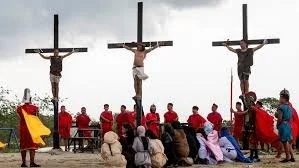
So, here we are, once again sitting at the foot of the cross, witnessing the unthinkable act of crucifying the Messiah. Watching soldiers carry out their unjust orders, listening as religious nationalist leaders whip up the crowd to support an insurrectionist rather than the Son of God.
For years I've preached on Good Friday, and I've always said that WE should put ourselves in that place and that time, because we are part of the human race that did this thing. And all those years I've treated that theoretically...hypothetically. Theologically.
But this year. This year, I don't know, y'all. It seems a lot closer somehow. When our own Secretary of Defense, at a recent prayer breakfast, urged got to rain down “overwhelming violence of action against those who deserve no mercy,” I have to wonder how our leaders would react if they heard Jesus beg, “Father, forgive them, for they know not what they do.”
Maybe I don't wonder about it. Because I think I know how they would react. It's been this way for centuries.
I don't think Jesus stands a chance against what we are showing ourselves capable of. He didn't then, and he doesn't now.
Let's face it, most people, when they see acts of injustice by those in power, they don't speak up. Like the apostles, they run and hide. Like Peter, they deny knowing Jesus. How many of us whisper conversations in diners or offices or other places where people gather for fear of being overheard by society's bullies? Just like the apostles.
How many people see institutional cruelty and wash their hands of it, just like Pilate? We don't want to get involved.
How many of us stand on the edges of the crowd, watching Jesus hang there, in limbo on that cross, knowing that sooner or later there will be no one left to stand with us? But it hasn't happened yet. And surely things will change before then.
And the empire rolls on and emperor after emperor gets further and further removed from life on the ground. And the crucifixion of this one man, one man among many in that neck of the world, won't affect the markets one little whit.
And Jesus' life blood will seep away on that cross, and his eyes will glaze over, and he will breathe his last. He will give up his spirit. And at that moment, this world will be truly alone, left to our own devices, left to the shaky judgement of those who make those decisions that none of us here would ever want to make.
It is a strange theological phenomenon, what happens on this day, this Good Friday. When Jesus dies, he leaves this world. And that spirit that inhabits the church is not here. In a very profound way, when this service is conducted, the church dies, too.
This building is no longer sacred, at least not at this moment. It's so that when the sun goes down Saturday night, our light begins to shine again, and when Sunday dawns, we can sing “Welcome, happy morning!” But for now, in many ways, this is now just a building. Because Jesus gave up his spirit. And we still have had a hand in that. Even now.
But during this time of alienation and isolation, of abandonment and sorrow, we have been given an opportunity. Even in death, Jesus leaves us a gift. A chance to reflect on what it means to truly follow. Not just what it means to follow when times are great, but what it means to follow when hope seems lost. During this dark time, we find out who we are. Who we really are.
So can we find it in ourselves, on this day, can we find it in ourselves to stop dwelling on our own sufferings and turn to others, like the bandit who saw Jesus hanging in pain next to him and who had his heart go out in love for a man in whom he saw the face of God?
Can we find it in ourselves to stand bravely at the foot of the cross like the women in our story – not the men, they are skulking away – like the women in our story? Openly weeping, letting the world see their allegiance. Not to a country or an emperor, but to one they loved, who loved them, and who changed their lives.
Can we find it in ourselves to stand up to the authorities, like Joseph in this story, who overcomes his fear and asks Rome to treat this wrongfully maligned messiah with the respect he's due, with the honor he deserves?
Can we find it in ourselves to abandon our old beliefs about others, the sneering at those who are different from us, who we see as less than us? Can we change like that Roman centurion, who watches these final moments at this Place of the Skull, and begins to question his beliefs with a single statement: “Surely this man is the Son of God”?
These are the questions of Good Friday. As we leave here today, wondering what will happen next, pondering the emptiness in the world on this day, these are the questions of Good Friday.
The rest can wait for a few more days. But today, we pray for our broken world. Today, we weep for our broken world. We weep. For all we've done, and for all we've failed to do, we weep.