
So, I think most of you know Andreia Keller. She's lived among us here in the New Berlin area for several years, post-COVID. And she's been involved with our churches during that time. Now, to be honest, that's been rocky at times. Andreia is, how shall I put this? Brazilian.
She brings all that Latin energy and craziness to everything she does. If Andreia and you were to discuss where to go for lunch, she'd be there and finishing up dessert before you even said, “I dunno, Gilligans?”
And here's the thing, she wants to be a US citizen. Lately, I wonder why. I mean, over the last several weeks, she's been terrified that when she got to the federal building in Syracuse, masked federal agents would swoop down and carry her off, never to be seen again before she could take her citizenship test.
And yet, she sees something in us that she wants to be a part of. Something that is still robust and happy-go-lucky and winsome. Something that I have trouble seeing right now, but is still in her heart. She has looked at us and decided we're worth it. And when she is finally sworn in later this month in Binghamton, I have a feeling that everyone within her presence will remember that day.
I was thinking about her this week when my old boss in Knoxville, Fr. John Mark, called me with some bad news that he thought I'd want to hear. A parishioner of ours, another Brazilian, Rico, was found dead.
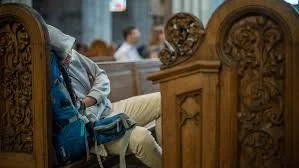
Rico was part of our homeless ministry – Mercy Church. He lived in an abandoned train engine, and he showed up all the time with a huge smile, talking a mile a minute and was an integral part in making sure that our group stayed on the straight and narrow and didn't veer off to far into theory and the clouds.
He appreciated that we offered a place of silence, a place to come down off a high or sleep off a bender. We brought out cots for the colder nights, and we started reading scripture together.
Reading Bible stories with those folks was incredible and challenging and sometimes a little weird. The religion professor from the University of Tennessee led the conversations but didn’t try to teach scripture. He tried to draw out what these scriptures meant for the gathered congregation. And let me tell you, I’ve never had my scripture reading worldview challenged so consistently than I did down in that church basement.
So, one day after Mercy Church, I took Rico to a pizza place around the corner. He picked the spot because this little pizza joint used to be a hot stop on the punk scene. Blondie and The Clash and Green Day had played there, and the air still had the feel of a place the establishment ought to avoid.
We sat over greasy slices and wiped our fingers on see-through napkins while Rico started talking and I started shutting up. Rico told his story, that he went from being a husband and a dad to neither in the blink of an eye on the interstate when he and his family were in a car crash in Georgia.
He talked about how hard he fought to stay sane, to stay whole, to stay in the rat race, but nothing seemed to make sense. He didn’t want every day to be a fight, so he stepped back, little by little, until he’d crafted a life he loved. From the locomotive, he felt safe.
He had a roof over his head and a place to come in from the cold. He had a door, if he wanted to use it, but he rarely wanted to use it. He could watch storms blow through. He improved his English and read through nearly the entire downtown library’s collection and started working through satellite locations, too.
Rico even had an unofficial deal with the rail workers. They knew he was there, but they didn’t bother him so long as he’d keep an eye out. Rico was a good dude, and, in his mind, he was not down on his luck.
He chose this life. And he didn’t want your pity or mine. What he wanted was to help other folks and to live a peaceful life. And what he really wanted is for people to stop looking at him like he’s wrong just by existing and seeing things differently.
Talking about his experiences on the street, he had a lot to say about Jesus and the Christians he’d seen. The line that brought me up short over lunch was: “They sure find a lot of reasons to hate folks they think God wants them to hate. But they never seem to come around to loving the ones God tells them to love.”
Now, our Samaritans today weren’t all that different from what Rico was getting at. They were a different group of people, but they weren’t all that different from the Jews. When the Assyrian Empire destroyed the Northern Kingdom of Israel 700 years before Jesus came along, the survivors were deported and spread across the conquering empire.
But the tiny remnant that remained, they’re who the Samaritans came out of. And when later Jewish exiles returned home, there were some issues in how to use the space that have lasted to this day.
The ones who had stayed back said they were the true faith because they’d remained unchanged. The ones who had been sent into exile said they were the true faith because they’d gone through a difficult trial and HAD changed.
The exiled folks that returned ended up growing into the dominant group, and the Samaritans (the ones left behind) lost out, and by the time Jesus came around, no one wanted to cross the line and see the others because that was a reliably unpleasant experience.
But today Jesus goes to this place deep in Samaria. You don’t go there by accident. But that’s where he chooses to go. It’s just not done. So Jesus is up to something. The whole world said he was supposed to hate the Samaritans, and the root of that was supposed to be in some truth about God that people told each other.
But God didn’t separate out the Samaritans like chaff, the people did that. And in spite of the hate that people said God wanted them to carry, Jesus goes to them and offers the first person he sees eternal life. And that offer is an offer of love.
We know it’s love because just last week we heard that God sent Jesus because of love. All that he does is a message of love meant to show the world who, exactly, it is that God loves. And come to find out, that’s everybody.
God loves the people. Regardless of who they are, what lives they were born into, their status, orientation, race, gender, faith. In spite of all that we are, God loves us and crosses all sorts of lines to show us that love.
Thinking back to Rico and our pizza slices before I went home to my cozy apartment and he to his 200-ton locomotive, I can’t help but hear his line echoing in my head. “They sure find a lot of reasons to hate folks they think God wants them to hate. But they never seem to come around to loving the ones God tells them to love.”
Assuming Rico’s right, who does God tell us to love? The Gospels say to “love your neighbor.” And if we follow Luke’s totally reasonable follow-up question, “Who is my neighbor?” we end up right back where we started. With Samaritans, in that case, The Good Samaritan, the only person to show love. A person Jesus' people were saying to hate.
Who is our neighbor? Is it the “good people” of God who cross the street when they see someone disagreeable in their path, when they see a body in a ditch or Rico’s tall frame standing proud? Or is it that one person who stops, the last person we “should” ever give the time of day to?
The hateful, the different, the loving, the easy to love and, especially, the hard to love? Whoever it is that we’re told we’re “supposed” to hate, that’s who. Who is my neighbor? If Rico were still alive, he'd say it’s all of ‘em.
Amen.