
So, when I was in seminary, they loved to make us take various and sundry personality tests, like the Myers-Briggs or the Minnesota Multiphasic Assessment. Most of the time, I did these with a small bit of grumbling. I mean, so, I end up being an INTJ or something, what am I supposed to do? Tattoo it on my head? But there was one test that I kinda was intrigued by. It was a Strengths Finder Test.
It measured 34 different aspects of a person and told you what your top strengths were as you moved through life. Now, to be honest, I don't remember what my strengths are...I'm sure I had some. But what I liked about this test is it described your strengths in terms of “balconies” and “basements.” Balconies were how your strengths could manifest themselves in good ways. And basements were those strengths manifested in bad ways.
So...and bear with me now...so, let's say I measured high in “Achiever.” This means I would be tireless and have a strong work ethic. That's if that strength were manifesting on the balcony. But it also has a shadow side that shows up as “overcommitted, can't say no, burns the candle at both ends.”
Or, take the strength of “belief” where you would have strong core values. On the balcony, this shows up as “steadfast, ethical, and responsible.” But it could also mean you're “stubborn, elitist, set in your ways, and opinionated.”
All this crossed my mind when I was Zooming with my mom the other day. As most of you know, she has moved to a retirement village on Signal Mountain, outside Chattanooga. During the move, she had to do some radical downsizing of her stuff, but we were amazed at how much of her stuff she was able to keep from her 4-bedroom house and cram into her 2-bedroom apartment.
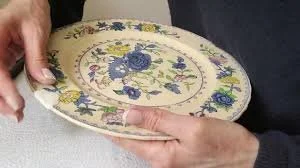
But recently she begun to realize that she kept too much and she's tripping over it, and all that clutter is beginning to drive her crazy. So, she's giving things away. And the hardest thing to give away is her china set.
She has this really nice china: plain white surrounded by a band of platinum. We talked about it for a bit, why this meant so much to her when we never, ever used it. It always just sat in a cabinet. And she said that when she was growing up, having nice china for dinner parties was all the rage. It meant that you cared about the people you had invited because you were trusting them to behave and not break things. It meant that you had manners and were proper. It's what you did to show that you were somebody.
When she was adulting in the 60's, not having china meant you were poor or low class. We looked at each other, and finally she said, “I guess china means you are better than other people.” And there it was, the shadow side of “being somebody. “
When my mom was growing up, this was clear all over the place in the South. And it manifested itself in a particularly cruel way: “whites are superior to blacks.”
She remembered a story where her Aunt Mary offered to give her black maid some china that she was going to get rid of because it was chipped and several pieces had going missing over the years. And she was offended that the maid said, “Thank you, but no. I already have some.” And on that Zoom call, my mom said, “I love your Aunt Mary and miss her, but you know, maybe I don't need the china after all. Who do I need to impress?” She had put two and two together, and we didn't really need to talk about it anymore.
Y'all, we're still doing that, aren't we? Lately, thanks to the Supreme Court, states all over the South are crawling all over each other to see who can redraw electoral maps to remove African Americans from whatever political power and influence they might have gained in the last 50 or so years. And don't kid yourself when those fine, white (mostly male) Christian politicians talk about trying to achieve a colorblind society. This is no balcony trait here. Those states, Tennessee included, are leaving the balcony of racial equality and returning to the basement of Jim Crow.
And it will manifest itself, as it so often does, in hatred for marginalized groups that they have deemed inferior. Black and brown people, gay and trans people, people who see the world differently, people who worship differently. This loyalty will manifest itself in hatred of difference, and fear of the unknown. And it will be wrapped up in good old, familiar, white Christian nationalism.
I wish this were something new. But it's not. How many wars, how many genocides, have begun this way? How many people have been enslaved, how many cultures have been destroyed because of difference? Y'all this is not God's way. And this is not how people of God should be. I know it seems self-evident, but, y'all, I don't think that people who say they follow God in this country are listening to that, are living into that. They like their God to be stern, giving them permission to dole out punishment for those who wander off the narrow path they, themselves, set forth. No differences, no variety, no “spice” of life. Just the same, saltless plate of bleached white grits, offering nothing but the barest sustenance to the soul. No risk, just good ole comforting white bread white male whiteness.
But y'all, when he left Haran for Canaan, Abraham left all that was familiar – all his customs and comfort, family and friends, all regularity and rhythm of his narrow life. His journey moved from present clarity into a future of genuine and profound ignorance. Abraham journeyed from what he had to what he did not have, from the known to the unknown, from everything that was familiar to all things strange.
But in his journey into the unknown, Abraham embraced his ignorance. He relinquished control. He chose to trust God's promise to bless him in a new and strange place. But this required a second choice on his part. Not only did he have to leave his physical home, he had to leave behind his narrow-minded, small-minded, parochial vision. He had to forgo the tendency to exclude the strange and the stranger. He had to listen to God when God said that through Abram, all mankind would be worthy.
When God called him, Abraham discarded conventional wisdom and moved beyond the fear of the unknown, the fear of inclusion, the fear of relinquishing power. Instead of lamenting his ignorance and the loss of control, he embarked upon a journey into the unknown. Instead of fearing inclusion of the strange and the outsider, he gave himself to God's promise of a universal blessings for the whole earth by becoming the outsider himself. In the face of his own profound smallness, he believed that God could do the impossible. In doing so, he became "the father of us all."
Jesus tries hard today to hammer it through the thick skulls of those who believe that their way of life makes them superior to others, who believe that others are NOT worthy.
Our common tendency is to fear the other, but today Jesus calls us to love them. Our common tendency is to suspect and marginalize the strange, but Jesus calls on us to join them in mutual trust. Or common tendency is to dismiss all that's different from who and what we know, but Jesus calls on us to embrace and accept different people as worthy of God.
And y'all, this is needed today more than ever.
I suppose that when more and more states march boldly into their racist past, we are going hear amazingly vicious and hateful bile spewed out by scared and hating people. And I assume that people are going to get hurt, maybe even killed. We've already seen what's happened to migrants. But I also believe that this will not be the end. Because I believe that God moves through the world one person at a time, embracing the better life that God promises Abraham.
And I believe that my Mom will give up her china with no problem and no regret, and move on to a better life, a little less weighed down by her past, embracing the better life that God promises Abraham.
And I believe that there are more followers of Abraham like my mom. And I believe that one Abraham will beget another and another and another. Each of them, following God into the unknown with trust and love, embracing the better life that God promises us all.
Amen.